Friday, 11 November 2016

Simple Sampler QAL- Triangles and a bonus extra

For those of you following the #simplesamplerqal,  using my tutorials on Sewing Directory, these are the three most recent blocks.   Hourglass which uses half-square triangles to make quarter square triangles- a bit of trimming involved but not real waste:


Flying Geese block.  The method for the is a traditional technique which is straightforward but it is a little wasteful.  It's one of those methods that it's good to know as it helps beginners understand how the geese shape is formed but there are alternatives once you've mastered this. There is also a bonus to this method (see below).


When you come to stitch the diagonal seam line, if you pencil in a second line half an inch away from the previous seam and sew a second seam  on the part of the square which will be trimmed off, you will end up with some extra, smaller half-square triangles that could be used on another project!  Once the second line is sewn, cut between the two lines.  To make each of the eight geese needed for this block, you could generate two half-square triangles so a bonus of sixteen at the end, maybe to use to make a pot holder or mug rug?


The Sawtooth Star uses geese made with a no-waste method.  This works well for solids or non directional prints and there's no waste and minimal trimming, one of my favourite methods- it's fast too.


I'm enjoying making these blocks for a second time!

Wednesday, 9 November 2016

November at Village Haberdashery

I think it's time to think about Christmas making, I had all my Christmas fabrics out yesterday to plot some decor ideas for work so for my visit to Village Haberdashery I'll be looking at seasonal fabrics and ideas.  I have an unashamed love of Christmas novelty prints from the subtle wintery whisper prints to the familiar Christmas motifs in red and green!


From left to right, row by row:
  1. Juniper Berry- Reindeer Games in Winter vanilla
  2. Cosy Christmas- Recipe in red.  There's a brilliant free tutorial on the shop blog on how to make the domestic goddess retro apron too. 
  3. Holiday - Corny Cane in Green.  Wonderful retro themed Christmas collection of prints from Michael Miller including these candy canes on the perfect Christmas green background.
  4. Holiday- Fawn Memories in Cream
  5. Dashwood Twist.  A modern basic in a wide range of colours (over 20!)- choose exactly what you would like with the build-a-bundle option.
  6. Lore - Fable Forest in Grey.  Subtle wintery print by Leah Duncan and printed on organic cotton.
  7. Sevenberry Penguins. Novelty print on lovely quality cotton. Penguins are 8cm tall. Suitable for dresses like the Emery dress or for quilting.
  8. The Emery dress.  If you want to use any of these fabrics to make a fun Christmas dress, the Emery dress designed by Christine Haynes is a classic, basic fit and flare style with long sleeve options for colder weather.  In-seam pockets are included and there's a ribbon that can be added too.   It works well sewn in quilting cotton, poplin or even flannel  (see those links for brilliant sewing blogger Emery dresses) and is a very versatile pattern. 
  9. Winter Essentials III- House in red

Tuesday, 8 November 2016

Autumn Leaves Go Anywhere Bag

I've made many bags over the years and almost all of them are from Anna Graham's Noodlehead pattens.  She writes crystal clear instructions and they've always been bags I have used and used.  The Go Anywhere bag pattern has been on my computer for ages and buying this wonderful Sevenberry linen/cotton tree fabric in Fabric Rehab's recent closing down sale (same print, different colour on sale here) was the impetus to get it made.


Fabrics
A mix of Carolyn Friedlander's Euclid linen/cotton blend prints- available here and here for the main bag and lining.  These fabrics use Robert Kaufman Essex linen as a base so they are wonderfully stable to work with.  I used Sevenberry tree fabric for the outer pocket and some left over mid-weight denim for the outer and inner pocket linings.  The beauty of this bag is that no other hardware is needed and interacting is minimal if you use heavier fabrics like these.  To interfacing the handle and to support the pocket, I used Pellon Shape Flex SF101 (hard to find in the UK but available here).   It's the best interfacing I've used for bag making and Vieseline is not quite the same.


It's a bag of many pockets- three on the front, two at the back (as below) and one inside.


I used a tote bag most days, enough room for purse, phone, keys and groceries for whatever we are eating that evening. 


It's a straightforward pattern, my only extra tip was to try out something I saw on someone else's blog or feed ages ago (sadly I can't remember who) and use a little piece of plastic canvas to support the back of the magnetic fasteners.  The canvas is trimmed to size and fits behind the fabric and is followed by a snippet of wadding to stop the metal prods pushing into the fabric. 


As ever with Anna's patterns, I am really happy with the result and the bag has gone straight into use and compliments the amazing autumn colours this year. 


Anna's Noodlehead paper patterns are available in the UK- I found them at Minerva Crafts, Sew Hot, Pretty Fabrics and Trims and many more.   See other Noodlehead bags I've made here:

Thursday, 3 November 2016

Mini Apron FQ Stash Buster

Sometimes my two worlds collide, last week I sewed up twelve aprons for my day job running music groups for babies and children.  Our theme for the next couple of months is preparing for Christmas and we start the term with a baking song.  What better to go with our bowls and spoons than an apron for everyone to wear!


Each apron is double layered and sewn from two fat quarters and I used scraps for some of the pockets.  You can use the fat quarters either way directionally to produce different sizes although you do need to consider how the print works.   I was sewing for children from around 18 months- 4 years so I wanted a range of lengths. 
 Initially I followed this clever tutorial which produces cute curved pockets for a 'no waste' method, alongside this hand drawn infographic but after I'd sewn a few I went free style!


I turned to my stash of various ribbons and tape for the neck straps and ties and I dug into my dressmaking remnants so many aprons were backed with chambray.  


I also stitched up a special extra trimmed version as a Christmas gift (getting ready early). This would make a great gift for a child age 2-6 years, especially accompanied with a plastic mixing bowl and  spoon and maybe an easy recipe too.


I loved sewing these and I've been seeing them in use this week with my little singing bakers, adorable!

Monday, 31 October 2016

British Craft Awards 2017: Vote for me?

I saw this British Craft Awards 2017 badge on my Instagram feed and by going to vote I found myself nominated in the Quilting blog of the year category!
A surprise and a thrill to see myself there alongside some other very familiar names...hi Jo, Lynne and Ali!


Even after a bit of research, I'm not totally sure what the British Crafting Awards are.  They cover many categories, (sewing, quilting, paper craft etc.) and Immediate Media, who produce many craft magazines, are behind them, that's all I gleaned from Googling.  I don't think there is an actual prize, rather the recognition that you are a part of the craft industry.  You can vote for the category of your choice (or all the categories) here.  It's relatively straightforward and there's a prize draw of Amazon vouchers for those who vote.  Realistically, it may be a bit of a long shot for me but, who knows!  I'll wait and see and it's lovely to be in the running.   

Sunday, 30 October 2016

October at Eternal Maker

Time for my monthly visit to Eternal Maker and my colour palette is definitely Autumnal!  I've included a mix of brushed cotton, lightweight chambray, linen cotton blend, rayon/cotton double gauze and quilting cotton alongside some pattern suggestions. 


From l to r, row by row:
  1. Kokka, pressed brushed cotton,Rings in mustard.  The description of this fabric is very interesting; the circle ring image is pressed into the fabric.  Suitable for skirts, jackets and trousers.
  2. Robert Kaufman cotton chambray-dot in indigo  Floaty chambray, great for dressmaking although you may need to line some skirts.
  3. Girl and the squirrel Iris tee kit.  This includes the Two Stitches Iris Tee pattern (age range 6 months- 9 years) and fabric to make a Tee up to age 5 years.
  4. Kokka Botanica black/monochrome linen blend by Ellen Luckett-Baker.
  5. Deer & Doe Belledone Dress pattern.  Deer & Doe patterns are now available to buy from online stockists and Eternal Maker stock many of their designs  including this classic dress
  6. Kokka pressed brushed cotton rings in charcoal
  7. Sevenberry Landscape in grey.  Beautiful print on Japanese cotton.
  8. Nan Iro Rayon double gauze, triangle blue (Kokka).  This is a new one for me, rayon (lyocell) cotton double gauze.  I'm imagining this is extra drapey and what a gorgeous print.  I'm also thinking, gathers, unpressed pleats tops and dresses- the Liesl Gallery tunic/top would be a easy choice for this and the Deer & Doe Aubepine would be perfect too.
  9. Kokka, yellow/monochrome linen blend fabric by Ellen Luckett Baker.


Thursday, 27 October 2016

Piecing Makeover, Patty Murphy: Book Review

I enjoy reviewing books from time to time and I choose the titles carefully; I only have limited shelf space and I want something I am going to use, not just coffee table inspiration (although I don't totally rule that out!).  I saw Piecing Makeover by Patty Murphy and it's alluring strap line, 'Simple Tricks to Fine Tune Your Patchwork' and I had a feeling with my love of quilting tips it was going to be my kind of book...

If like me you like finessing your piecing and learning new tricks to improve your piecing accuracy, this is the book for you.  I'm not familiar with Patty but her blog is here is you want to read more about her.  It's easy to read with a photo rich layout, so you can get up close with common piecing issues and be given common sense and easy solutions to those problems.   Either work you way through it for a bit of everything or head straight for the contents page and choose a particular block or feature that you'd like to discover techniques for and read some common problems and their solutions.  


As a fan of piecing/quilting tips - as well as Pinterest boards I keep a photo folder of screen grabs of some of the best I see online - I did wonder if there would be sufficient new stuff for me but yes, there definitely is.   Patty's advice is  knowledgable but not judgemental or dogmatic, e.g. in the basics section at the start of the book, the age old pressing seams debate is addressed in bullet points.  Some quilters like to be told- definitely press one way/open etc. but I feel the decision needs to be based on many factors- fabric colour, bulk, the sort of quilting that will be used etc. so I agree with Patty, firstly you need to know what the different options are and then "Overtime you will learn to anticipate the best way to press a block and think it through before you start".


 I wanted to test a new tip on a project so I plumped for half triangle piecing.  I had some cushions in mind using some souvenir fabrics bought in Amsterdam on a summer holiday plus some stash fabrics and the only way I had thought for piecing large half-rectangle triangles was hand drawn paper piecing templates on very large paper- I was planning on making 18" square cushions so larger than A4/letter paper allows.  Patty suggests a method and I carefully followed her with some test fabrics.  Like many of you I'm sure, I often have a mental block when working with diagonals so I referred constantly to the photographs, made sure my diagonals ran the same way and it worked a treat.  It is still a tricky shape; once the block is pieced it needs trimming down and I put washi tape on my ruler to help with this as you can't line the ruler with the 45 degree diagonal line like you would with a half-square triangle.  
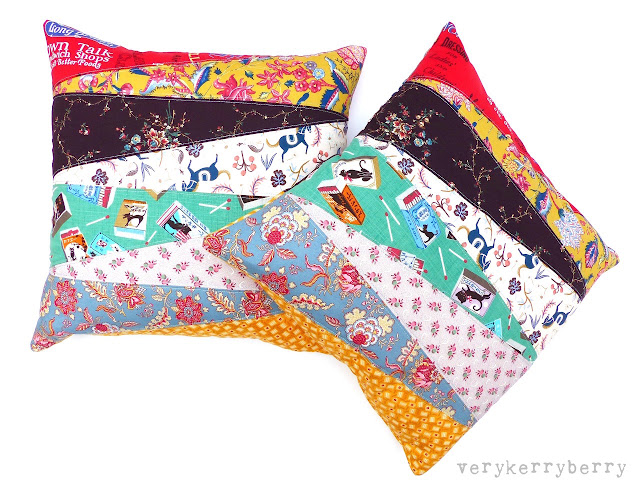

As you can see, I came out of it with a pair of half-rectangle cushions.  The nature of this block is that it will make a pair and I was replacing two pillows so it worked out perfectly for me.  


I'm working my way through this book.  The pictures are large and there isn't too much text on the page so I find it a great book to read whilst sitting on my bed and I mark pages with post-it notes or commit tips to memory.  It does lack an index which is a shame because at it's heart it is a reference book and although the contents page is relatively comprehensive, I can't quite understand why it doesn't have one - that's my only grumble.


As you can see, the Problem-Diagnosis-Solution concept repeats all the way through the book.  In amongst the various advice there are some great rescue remedies for that moment when you think you've really messedup.  Sometimes those moments create the defining feature of a quilt although it  doesn't tend to feel like that when you realise your border fabric is 4" too short or you've trimmed a block a little too much.  Piecing Makeover is going on my shelf next to my other favourite quilt reference, Erin Burke Harris' Quiltessential which I use to check things like quilt maths or techniques that I don't use very often.  This would also  be a great book for a guild to club together, buy and use at meet-ups, maybe even share their own clever tips with each other.  Available at the usual places.  
(I requested this title and was sent a kindly sent a free copy by Search Press.)
SaveSave